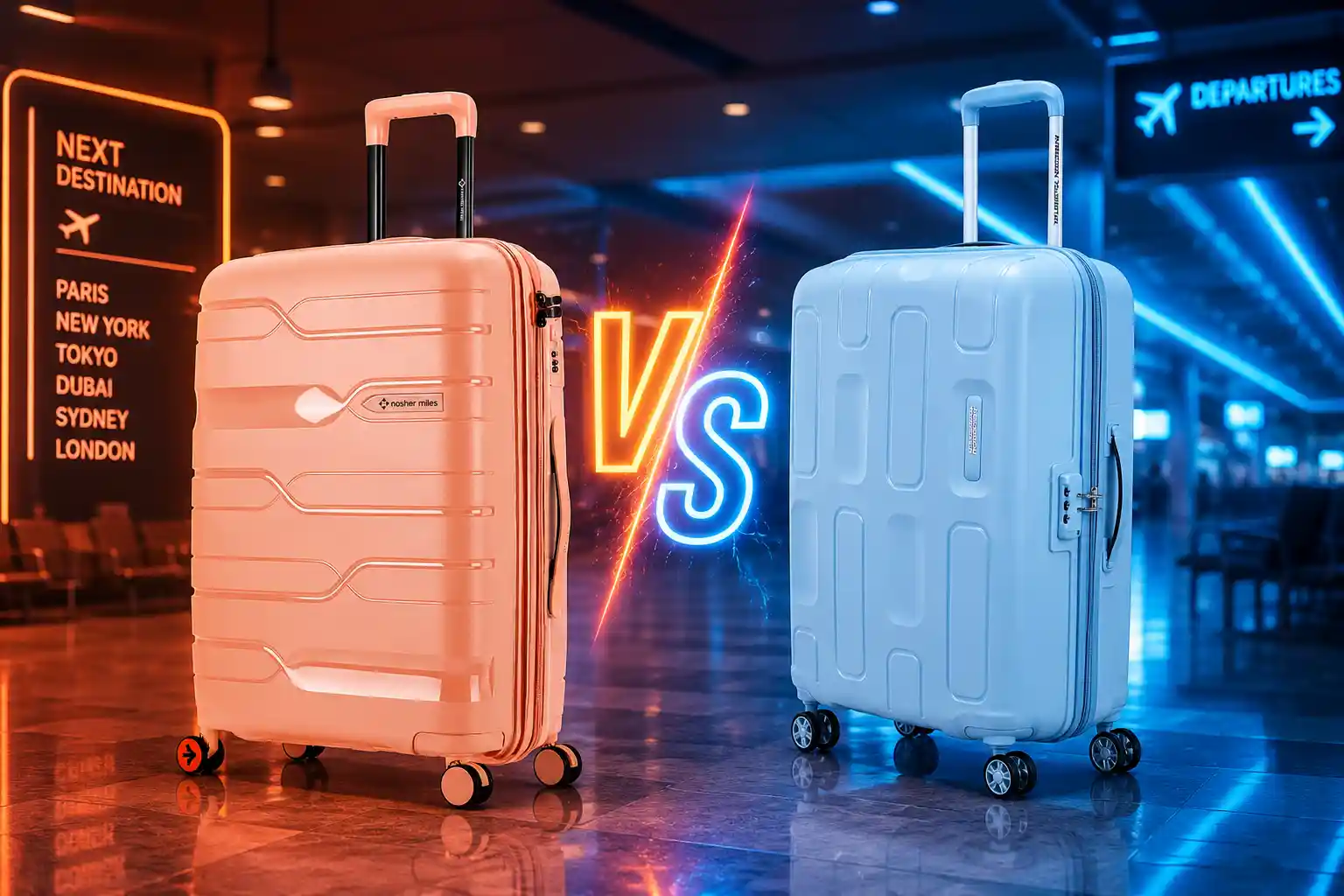
Buying a suitcase feels simple right up until you open eight browser tabs, read eleven reviews, and still can’t decide. That’s usually when the Nasher Miles vs American Tourister question shows up, because both brands often sit on the same shelf, sometimes even in the same price bracket, yet they come from two completely different worlds.
One is a scrappy, colour-loving D2C brand that walked out of Shark Tank India with a deal from all five sharks. The other is a 90-plus-year-old American name that now lives under Samsonite, the world’s largest luggage company.
This guide compares both brands honestly, section by section, using real specifications, brand history, and airline rules, so you can finally settle Nasher Miles vs American Tourister Which is Better for your own travel style without needing a coin toss.
Those Who Are In a Hurry!
Prices on Amazon keep changing.
How We Evaluated This Comparison
To create this comparison, I evaluated both brands across the factors that matter most to travelers. This includes luggage material, wheel performance, telescopic handle quality, zipper durability, TSA lock availability, warranty, after-sales support, customer feedback, and overall value for money.
Rather than comparing flagship products with entry-level models, I focused on luggage within similar price ranges whenever possible to provide a fair and practical comparison for Indian buyers.
Quick Comparison Table
Before going section by section, here’s a snapshot of Nasher Miles vs American Tourister side by side.
| Parameter | Nasher Miles | American Tourister |
|---|---|---|
| Founded | 2017, Mumbai, India | 1933, Providence, Rhode Island, USA |
| Parent company | Independent, D2C-first | Samsonite |
| Primary shell material | Polypropylene and polycarbonate | Mostly polypropylene, some polycarbonate |
| Typical warranty | 2 years shell + 1 year accessories (up to 5 years on select lines) | 2-3 years on most Indian collections |
| Approx. price range (India) | ₹2,000 – ₹16,000 per piece | ₹5,000 – ₹10,000 per piece |
| Wheel setup | 4 or 8-wheel spinners | 4 or 8-wheel spinners |
| Manufacturing | Shifting to Made-in-India | Samsonite’s Nashik, India, plant |
| Known for | Bold colours and design variety | Brand trust and manufacturing consistency |
Brand Overview
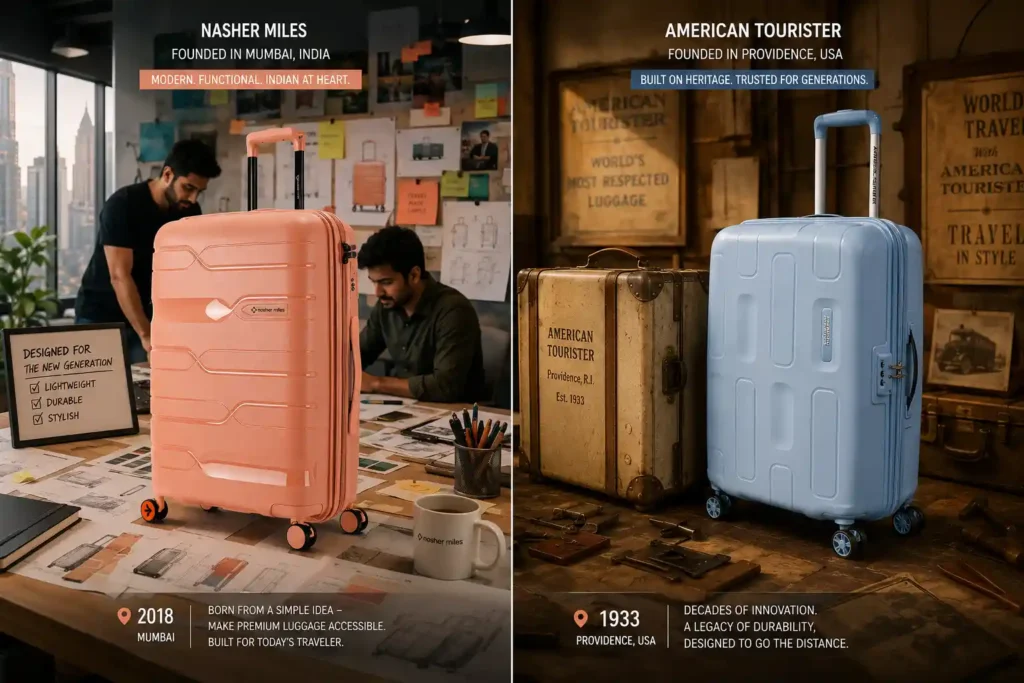
Understanding Nasher Miles vs American Tourister starts with two very different origin stories. Nasher Miles began in 2017 when co-founders Abhishek Daga, Lokesh Daga, and Shruti Kedia Daga noticed something odd about Indian luggage stores: everything came in black, navy, or grey.
So they built a brand around colour and personality first, function second. The bet paid off. The trio secured a five-shark deal on Shark Tank India Season 3, and revenue grew from roughly ₹2 crore in 2017-18 to about ₹146 crore by FY2025, with the company now targeting ₹200 crore for FY2026.
American Tourister carries a different kind of weight, literally decades of it. Sol Koffler founded the company in 1933 in Providence, Rhode Island, with one promise: a tough suitcase an ordinary family could afford. Samsonite acquired the brand in 1993, and today, according to Samsonite’s corporate history page, American Tourister sells across more than 90 countries under the same corporate umbrella as Samsonite itself.
If you’re already comparing luggage brands beyond just these two, it’s worth reading our separate breakdown of Safari vs American Tourister, since Safari competes in a similar price zone as Nasher Miles.
Product Overview
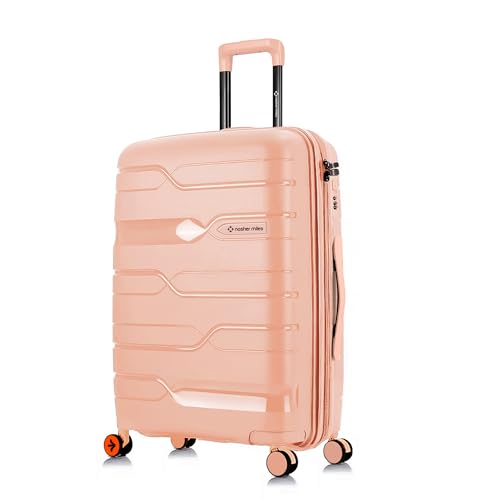
The Nasher Miles vs American Tourister lineup difference becomes clear the moment you browse both catalogues. Nasher Miles focuses on hard-shell trolley bags, soft luggage, backpacks, and travel accessories, spanning cabin, medium, and check-in sizes. Expect playful collection names like Paris, Zurich, Denver, and Canberra, plus a colour palette that reads more lifestyle brand than airport gear. The Nasher Miles Paris Hard-Sided Polypropylene Check-in Luggage is a good real-world example of this check-in range, built on a polypropylene shell aimed at riders who need one large, sturdy suitcase for longer trips.
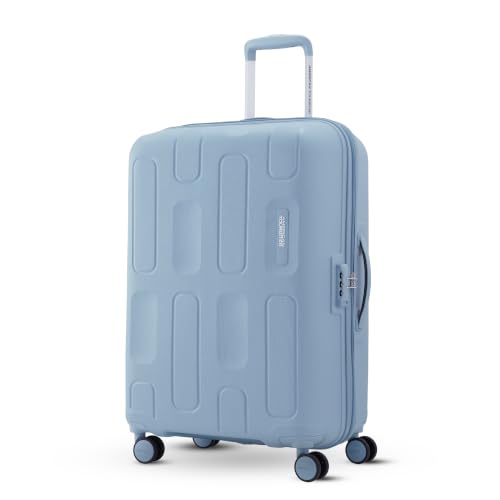
American Tourister’s India catalogue leans on established names such as Ivy, Airconic, Circurity, and Liftoff, covering hard and soft luggage, backpacks, and duffels. Samsonite deliberately positions this range between its own premium Samsonite tier and budget domestic brands. On the check-in side, the American Tourister Ivy 2.0 Medium Size Check-in Spinner Trolley Bag represents this mid-tier segment well, sized for typical domestic and short-haul international trips.
Design Comparison
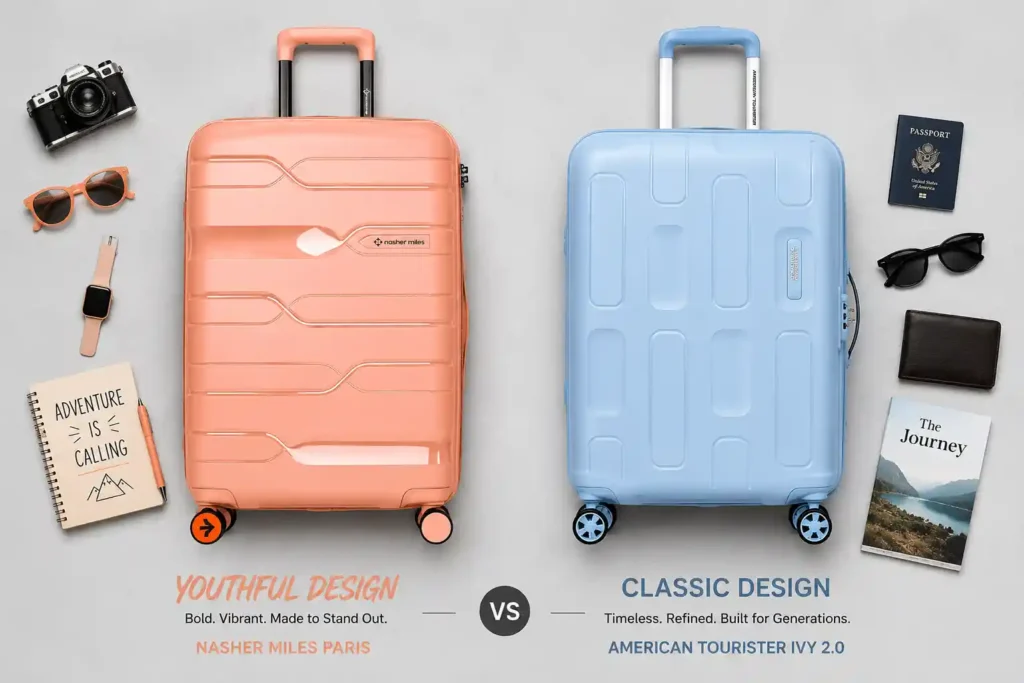
Design is often where the Nasher Miles vs American Tourister Which is Better question gets decided for style-focused buyers. Nasher Miles clearly designs for travellers who want their suitcase recognisable from three carousels away. Zig-zag textures, gradient shells, and unusual colourways show up across nearly every collection.
American Tourister keeps things calmer, favouring clean panel lines and a handful of safe, widely liked colours. Think of it as the business-casual option: dependable, never embarrassing, rarely head-turning.
If personality matters more than restraint, Nasher Miles wins this round. If you’d rather your luggage stay invisible in a crowd, American Tourister has you covered.
Build Quality
On raw build quality, Nasher Miles vs American Tourister comes down largely to manufacturing scale. Both brands build most hard-shell models around injection-moulded shells, reinforced ribbing, and framed zippers. Nasher Miles mixes polycarbonate and polypropylene depending on the collection, aiming for a shell that flexes on impact and bounces back rather than staying rigid.
American Tourister benefits from Samsonite’s manufacturing scale and shared India plant, which tends to show up as tighter panel gaps and smoother zipper action across batches, according to comparative brand reviews. That consistency comes from decades of tooling experience, not luck.
Material Quality
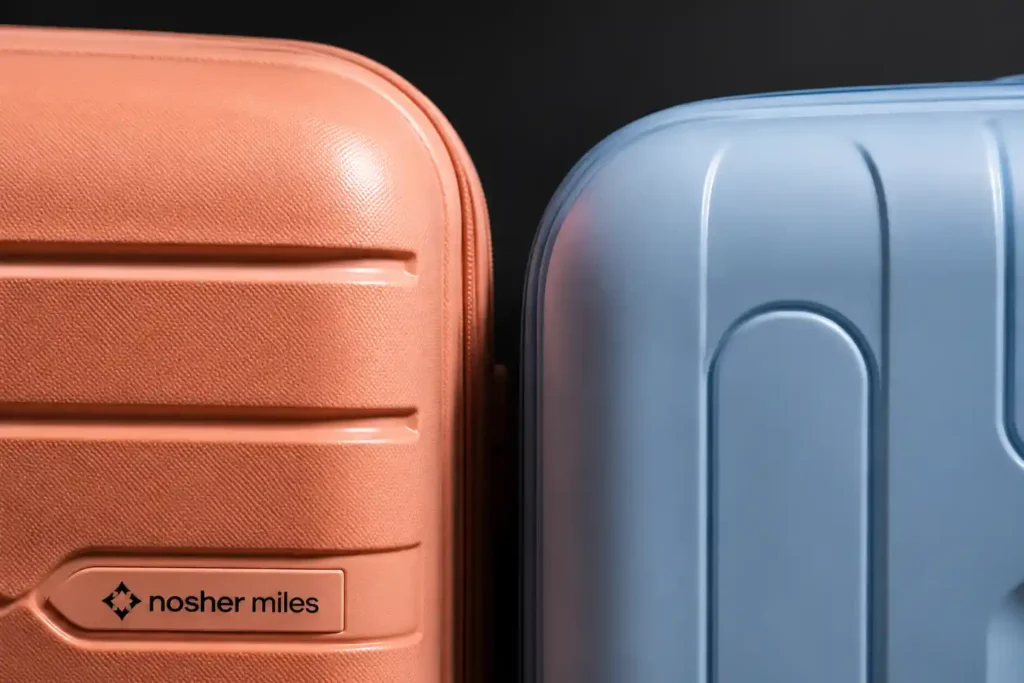
Material choice is one of the clearest ways to judge Nasher Miles vs American Tourister Which is Better before you even touch a suitcase in person. Three materials dominate the suitcase world: polypropylene (PP), polycarbonate (PC), and ABS. Polycarbonate resists impact best and springs back into shape after a knock. Polypropylene weighs less and costs less to produce, but flexes slightly more under pressure.
Nasher Miles uses both PP and PC across its range, and markets its polycarbonate lines specifically for scratch resistance and shock absorption. American Tourister’s mainstream India collections, including Airconic and Circurity, mostly use polypropylene, reserving polycarbonate for select lines like Ivy NXT.
That gap means Nasher Miles’ polycarbonate models can outperform American Tourister’s polypropylene ones on raw shell toughness, though PP still suits occasional flyers just fine.
If Samsonite’s own flagship materials interest you as a benchmark, our Samsonite vs American Tourister comparison goes deeper into how the parent and sub-brand differ in shell quality.
Wheels Comparison
Wheels are a small detail that quietly tips the Nasher Miles vs American Tourister Which is Better debate for many flyers. Spinner wheels changed suitcase life forever, and thankfully neither brand skipped that memo. Nasher Miles ships most hard-shell models, even cabin-size ones, with 8-wheel, 360-degree spinner systems, which genuinely help while weaving through a packed terminal one-handed with a coffee in the other.
American Tourister mixes 4-wheel and 8-wheel spinners depending on the collection, with 8-wheel setups showing up mainly in newer, higher-tier lines. For sheer glide-and-turn convenience across more models at lower prices, Nasher Miles edges ahead here.
Handle Quality
Nasher Miles typically fits aluminium-alloy telescopic handles with a wide grip, built to sit flush along the shell so packing space doesn’t shrink. American Tourister uses similar telescopic handles, and its push-button locking mechanism often feels marginally sturdier after years of daily use, likely thanks to Samsonite’s engineering background.
Both brands add top and side carry handles for lifting bags into overhead bins or car boots. Neither will embarrass you at check-in.
Scratch Resistance
Airport conveyor belts behave like sandpaper for suitcases, so scratch resistance matters more than most buyers expect. Nasher Miles markets several polycarbonate lines with a micro-diamond textured finish designed to hide surface scuffs. American Tourister uses a comparable matte, textured finish on many hard-shell models that similarly camouflages fine scratches.
In daily use, textured shells from either brand hide scuffs far better than glossy ones, so this round of Nasher Miles vs American Tourister ends close to a tie.
Storage & Packing
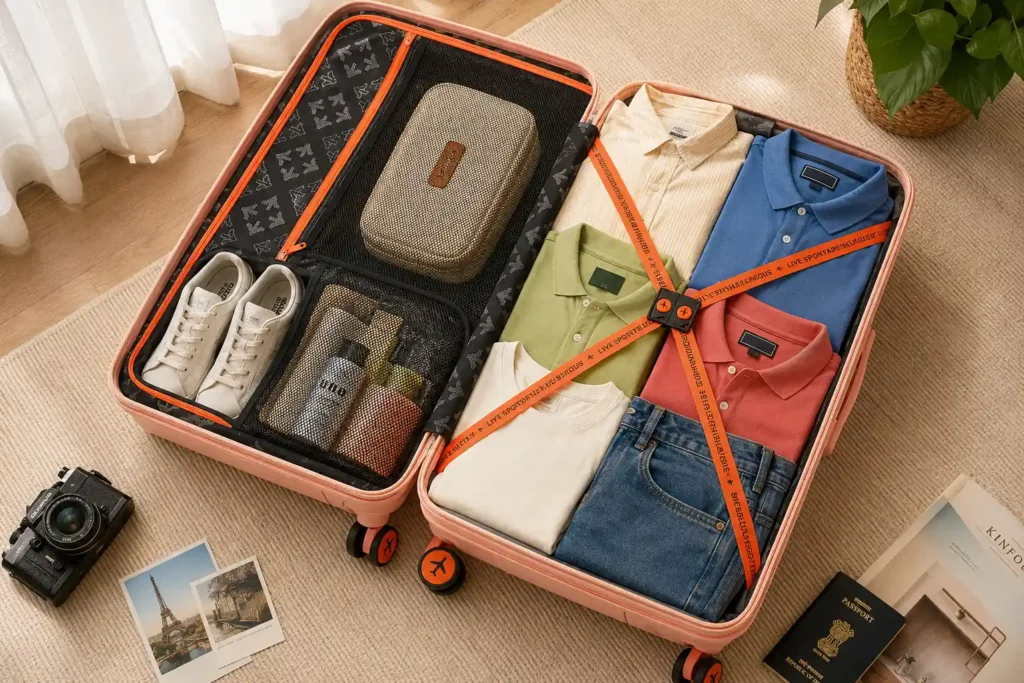
Nasher Miles suitcases generally include a zippered divider, cross-straps, and at least one mesh pocket, with several models adding a front quick-access pocket for a laptop or documents. American Tourister follows a similar interior layout: cross-ribbon straps on one side, a zip divider on the other, occasionally with a separate shoe or laundry pouch on premium lines.
Both brands offer expandable zippers on several models, typically adding 20 to 25 percent extra capacity for that one souvenir you swore you wouldn’t buy. On packing alone, Nasher Miles vs American Tourister ends up being a model-by-model decision rather than a clean brand win.
Airline Compatibility: Domestic and International
For frequent flyers, Nasher Miles vs American Tourister often comes down to which specific model fits airline rules, not the logo on the shell. Most Indian domestic carriers, including IndiGo, Vistara, and Air India, cap cabin baggage around 55 x 35 x 25 cm and 7 kg, though Air India specifically uses a slightly different 55 x 40 x 20 cm box, so it pays to double-check before flying. According to IATA’s official passenger baggage rules, a single checked bag should not exceed roughly 32 kg on any airline worldwide, a limit set by baggage-handler safety standards rather than marketing.
Both Nasher Miles and American Tourister sell 55 cm cabin models built around these limits, plus 65 cm and 75-80 cm check-in sizes suited to India’s domestic weight allowances and international piece-based systems used on US, UK, and European routes. Compliance depends on the specific model you choose, not the brand name.
Airport Experience
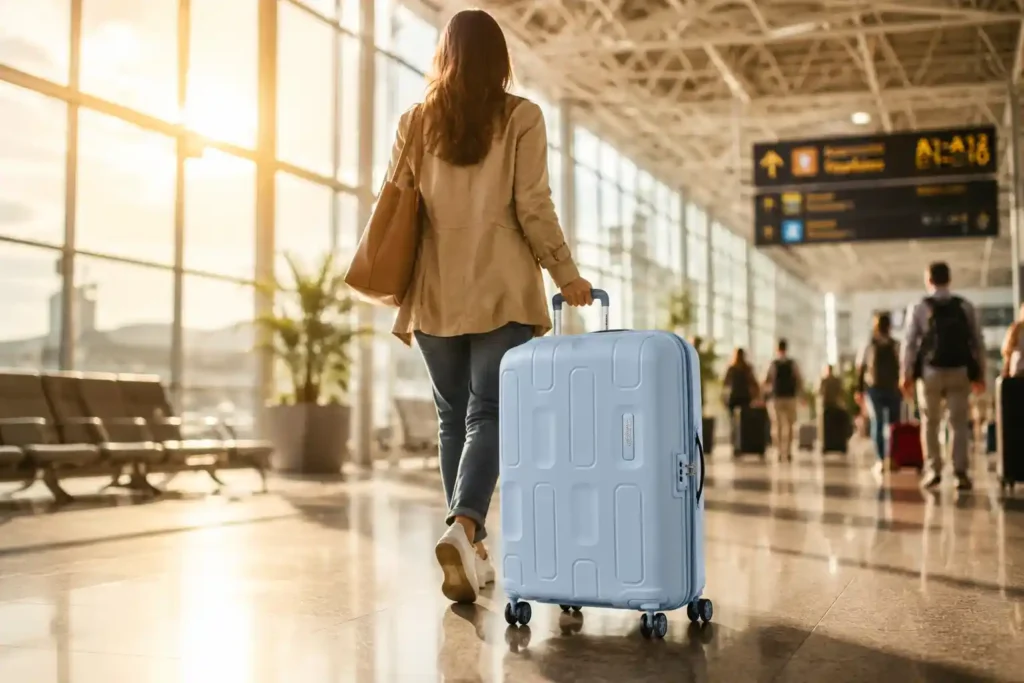
Weight is the real hero at check-in counters, not the material printed on a spec sheet. Nasher Miles’ cabin bags average around 2.5 to 3 kg, leaving more of your 7 kg allowance free for actual belongings. American Tourister’s lighter polypropylene models sit in a similar range, with its larger Airconic spinner weighing about 3.2 kg.
Spinner wheels from either brand roll smoothly across polished airport floors, and 8-wheel options manoeuvre through security queues and crowded gates with noticeably less wrist strain than older 4-wheel designs.
Railway Travel Experience
Indian train travel doesn’t enforce strict size limits the way airlines do, but overhead luggage racks and under-berth space stay genuinely tight, especially in AC 3-tier coaches. Lighter cabin-size bags from either brand slide under berths more easily than large check-in suitcases, which usually end up sitting at the compartment’s open end or chained to a berth leg.
Hard-shell luggage from Nasher Miles or American Tourister survives rough handling by porters and the shove-it-under-the-seat routine better than soft bags, since the rigid shell absorbs impact instead of your belongings.
Road Trip Performance
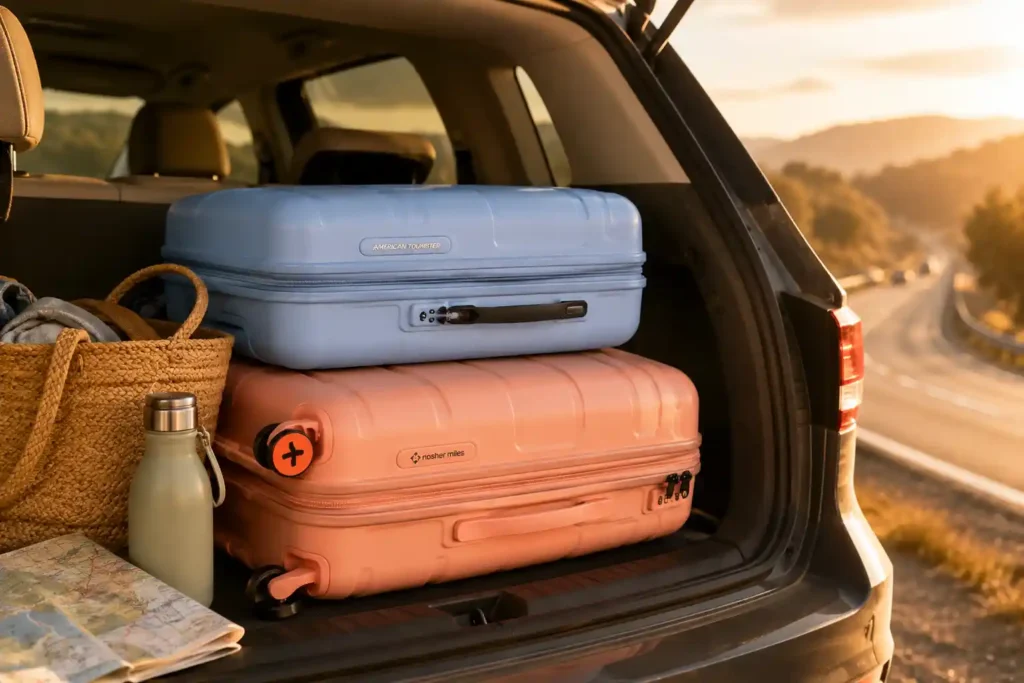
Car boots reward stackability, and hard-shell suitcases from both brands stack more predictably than soft duffels that bulge unevenly. Nasher Miles’ rounder shell corners tend to nest well against uneven boot shapes, while American Tourister’s flatter panels stack cleanly against similar hard cases.
Wheels matter less once a suitcase sits loaded in a boot, though 4-wheel designs stay flatter and resist rolling around during sharp turns better than 8-wheel spinners, which can shift on bumpy highways if not wedged in properly.
Durability After Long-Term Use
Long-term durability is where the Nasher Miles vs American Tourister Which is Better gets tested in real life, not on a spec sheet. Polycarbonate suitcases, handled reasonably, can last 5 to 10 years, according to Nasher Miles’ own product guidance, and that general rule applies across brands, not just one. Nasher Miles’ recent shift toward more polycarbonate and Made-in-India production aims squarely at strengthening this long-term durability story.
American Tourister benefits from Samsonite’s decades of tooling and quality-control experience, and comparative reviews note that shared manufacturing standards typically translate into steadier long-term performance, especially around zippers and wheel housings. Wear, cracked shells from mishandling, and scratches fall outside both brands’ warranty coverage, so realistic expectations matter more than brand loyalty when judging five-year durability.
Warranty Comparison
Warranty terms often decide Nasher Miles vs American Tourister Which is Better for cautious buyers who’d rather not gamble on a five-year-old zipper. Nasher Miles’ standard warranty covers 2 years on the shell and 1 year on accessories like wheels, zippers, and handles, with a few hard-side collections extending shell coverage up to 5 years. Wear, tear, and scratches from normal use stay outside this coverage, per the brand’s own warranty page.
American Tourister’s India warranty typically runs 2 to 3 years against manufacturing defects, depending on the specific collection listed on the product page, and it similarly excludes wear and tear or transport damage. Always photograph your bag before check-in if you want any real claim leverage later, since airline-caused shell cracks rarely get covered by either brand internationally.
Price Comparison
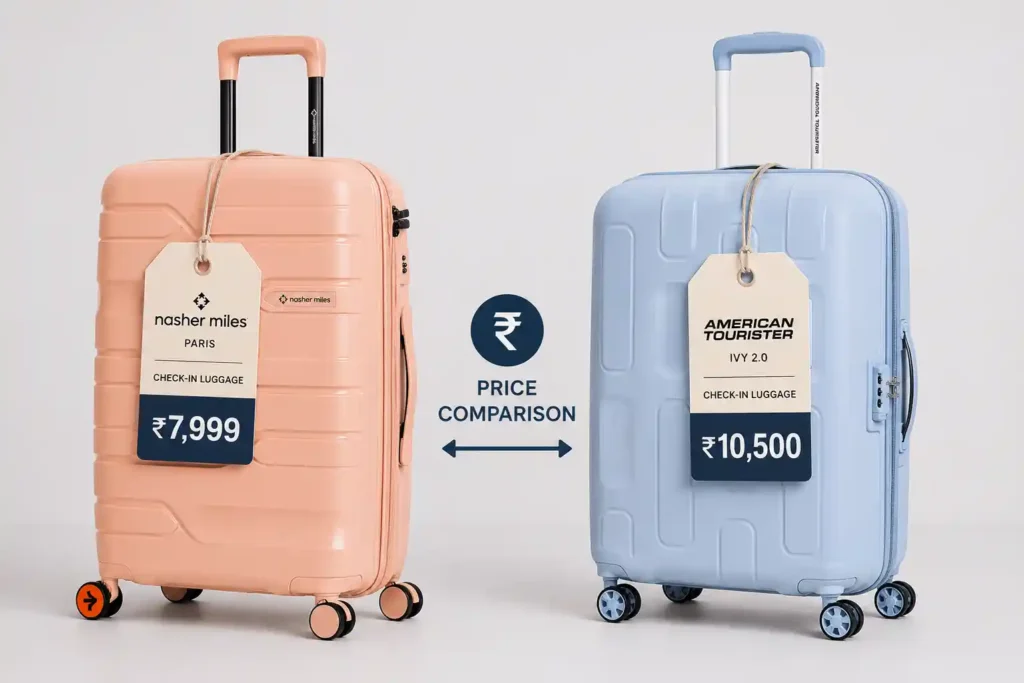
Price is usually the first filter people apply when comparing Nasher Miles vs American Tourister. Nasher Miles sits in the mass-premium bracket, with individual pieces typically priced anywhere from around ₹2,000 for soft polyester bags up to roughly ₹16,000 for larger polycarbonate hard-shell models, and luggage sets stretching higher before discounts.
American Tourister generally sits in the ₹5,000 to ₹10,000 range for most individual hard-shell pieces in India, positioned deliberately below Samsonite’s own flagship models, which start above ₹10,000. Street prices on both brands shift constantly with festive sales, so treat these figures as ballpark ranges rather than fixed tags.
For readers weighing yet another rival, VIP is worth a look too, and our VIP vs American Tourister comparison covers pricing tiers in a similar way to this guide.
Value for Money
Value for money reframes Nasher Miles vs American Tourister Which is Better into a personal budget question rather than a brand-loyalty one. If you want more colour choice and features per rupee at the lower end of the price ladder, Nasher Miles typically delivers more for less.
If you’d rather pay a bit extra for Samsonite-backed manufacturing consistency and a globally recognised name that resale buyers instantly trust, American Tourister earns its premium. Neither brand wins value outright; it comes down to whether design freedom or brand pedigree matters more to you.
Pros & Cons: Nasher Miles vs American Tourister
Nasher Miles
Pros
- Bold, wide-ranging colours and prints
- More 8-wheel spinner models at lower price points
- Lower entry price for budget-conscious buyers
- Rapidly expanding Made-in-India manufacturing
Cons
- Shorter brand track record than legacy names
- Warranty terms vary noticeably across collections
- Smaller international service network
American Tourister
Pros
- 90-plus years of brand history and trust
- Samsonite-backed manufacturing consistency
- Wide India and international service network
- Strong resale recognition
Cons
- Mostly polypropylene shells, less impact-resistant than polycarbonate
- Narrower colour and design variety
- Higher average price than Nasher Miles’ entry tier
Who Should Buy Nasher Miles
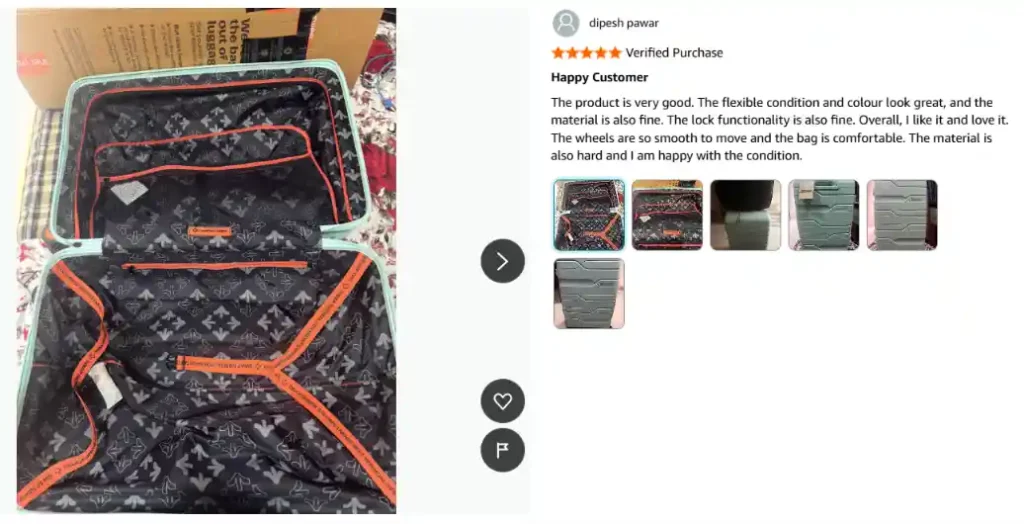
Pick Nasher Miles if you’re a younger traveller, a student, or someone who wants a distinctive-looking suitcase without paying premium-brand prices. It also suits buyers who prioritise 8-wheel manoeuvrability and don’t mind a newer, still-maturing service network. If you’re shopping for check-in luggage specifically, the Nasher Miles Paris Hard-Sided Polypropylene Check-in Luggage is worth shortlisting.
- Check-In Large (L): This 28-inch lightweight, hard-sided check-in trolley bag is perfect for weekend trips or traveling …
- Sturdy Design: Luggage trolley is made from polypropylene which is very resilient, durable and lightweight. The tough ex…
- Effortless Mobility: Easy maneuverability via 360-degree, 8-silent spinner wheels is provided for this lightweight serie…
Prices on Amazon keep changing.
Reviews on Amazon
Who Should Buy American Tourister
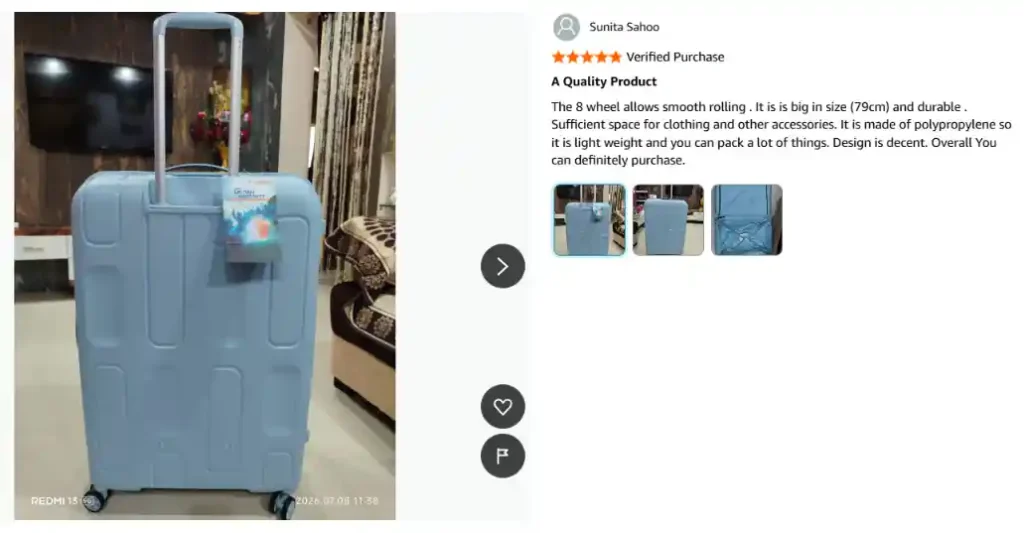
Pick American Tourister if brand trust, decades of manufacturing history, and a wide service network matter more to you than standing out at the carousel. It suits frequent flyers and professionals who want dependable, no-fuss luggage. For a mid-size check-in option, the American Tourister Ivy 2.0 Medium Size Check-in Spinner Trolley Bag is a sensible starting point.
- HIGH – QUALITY STANDARDS | Crafted with premium materials and rigorously tested for impact, drops, wheels, zippers, and …
- DURABLE POLYPROPYLENE SHELL | Built with a tough polypropylene hard shell, this trolley bag delivers strong impact resis…
- ENHANCED CONVENIENCE | Designed for effortless travel, this luggage trolley bag features smooth 8-wheel mobility that gl…
Prices on Amazon keep changing.
Reviews on Amazon
Final Verdict

Neither brand loses the Nasher Miles vs American Tourister comparison outright; they simply serve different travellers. Nasher Miles wins on design variety, wheel count at entry prices, and overall affordability, making it a smart pick for younger, style-conscious buyers.
American Tourister wins on manufacturing consistency, decades-deep brand trust, and a broader service network, which matters more to travellers who fly often and want zero surprises.
So, Nasher Miles vs American Tourister, which is better for you specifically? If your budget sits under ₹8,000 and you want a suitcase nobody else has at the carousel, go with Nasher Miles.
If you’d rather lean on a name that has survived nearly a century of suitcases getting thrown, dropped, and famously gorilla-tested in old ad campaigns, American Tourister remains the safer bet. And if you’re still undecided after all this, that’s completely fair; Nasher Miles vs American Tourister Which is Better genuinely depends on how you travel, not just what looks good in a review.
Why You Can Trust This Comparison
Every comparison on SwoopCart is independently researched using official product specifications, warranty information, customer experiences, and current market offerings. The goal is to explain where each brand performs well, where it falls short, and which travelers are likely to benefit most from each option.
FAQs (Because People Keep Asking)
1. Nasher Miles vs American Tourister: Which is Better overall?
It depends on your priority. Nasher Miles wins on design variety, wheel count, and price, while American Tourister wins on brand trust and manufacturing consistency backed by Samsonite. Neither is universally “better.”
2. Is Nasher Miles as durable as American Tourister?
Both brands build reasonably durable luggage. Nasher Miles’ polycarbonate lines can match American Tourister’s shell toughness, though American Tourister’s Samsonite-backed manufacturing tends to show steadier quality control across batches.
3. Which brand offers a longer warranty?
It varies by model. Nasher Miles typically covers 2 years on the shell, extending up to 5 years on select lines, while American Tourister usually covers 2 to 3 years. Both add 1 year to accessories.
4. Is American Tourister owned by Samsonite?
Yes. Samsonite acquired American Tourister in 1993, and both brands now share manufacturing resources, including a plant in Nashik, India.
5. Which brand is cheaper overall?
Nasher Miles generally has a lower entry price, with several models priced below American Tourister’s typical ₹5,000 to ₹10,000 range.
6. Can I carry either brand as cabin baggage in India?
Yes, as long as you choose a 55 cm model within your airline’s weight limit, usually around 7 kg. Always confirm exact dimensions with your specific airline before flying, since Air India’s box shape differs slightly from that of other domestic carriers.
7. How is Nasher Miles trolley bags?
Nasher Miles trolley bags perform solidly for the price. Most models combine polypropylene or polycarbonate shells with 8-wheel spinners and a 2-year shell warranty. Build quality feels consistent for a brand founded only in 2017, though it hasn’t yet matched decades-old, Samsonite-backed names like American Tourister on manufacturing polish.
8. Nasher Miles trolley Which country brand?
Nasher Miles is an Indian brand, founded in Mumbai in 2017 by Abhishek Daga, Lokesh Daga, and Shruti Kedia Daga. It isn’t an international import despite its English-sounding name.
9. Nasher Miles Which Country brand trolley bag?
Nasher Miles trolley bags originate from India, not the US or China, though some early components were imported. The company has been shifting a growing share of production to domestic, Made-in-India factories over the past two years.
Research & References
This article is based on official manufacturer specifications, warranty information, product documentation, airline baggage policies where applicable, and publicly available industry resources. Customer reviews and market trends are also considered to provide balanced, accurate, and up-to-date recommendations.
Our Editorial Process
Every article published on SwoopCart is independently researched to help travelers make informed buying decisions. I review official product specifications, compare features across leading luggage brands, analyze verified customer experiences, and update articles whenever important product information changes.
If an article contains affiliate links, they never influence recommendations or rankings. Products are selected based on their overall quality, performance, practicality, and value for money.