
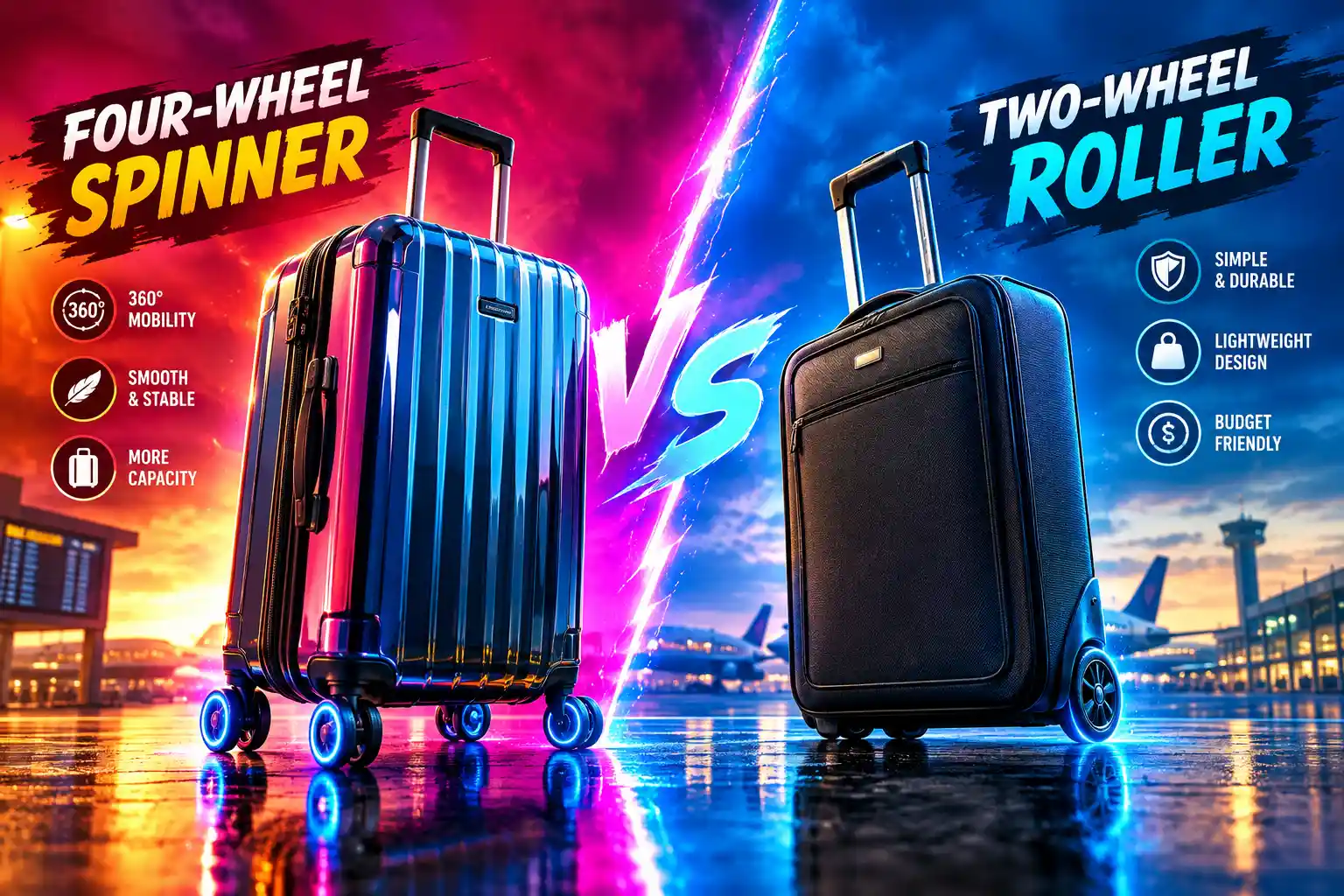
Every suitcase promises to make travel easier. Then you hit a cobbled lane, a crowded terminal, or a railway platform, and the truth shows up fast.
The real question in spinner vs roller luggage is simple. Which wheel setup suits the way you travel? This guide answers that with plain facts, a few jokes, and a checklist you can use today.
Quick Answer: Which One Should You Buy?
Short on time? Here is the fast version.
Pick a spinner if you walk mostly on smooth floors, such as airports, malls, and hotel lobbies. Pick a roller if your trips include rough ground, steep ramps, or long outdoor stretches.
Many travellers land in the middle. They choose a spinner for flights and city breaks, then keep a roller or a duffel for rugged trips. Both choices are valid.
What Is Spinner Luggage?
A spinner suitcase stands upright on four wheels. Each wheel rotates 360 degrees, so the bag glides in any direction. Delsey describes spinner luggage as having four wheels that rotate 360 degrees, allowing it to move in any direction with minimal effort.
You can push it in front of you, roll it beside you, or steer it through a queue with two fingers. Some spinners use eight wheels, with a pair at each corner.
One Mile at a Time notes that spinners are often hard-sided, while rollers are more often soft-sided. That is a pattern, not a rule, so always check the product itself.
What Is Roller Luggage?
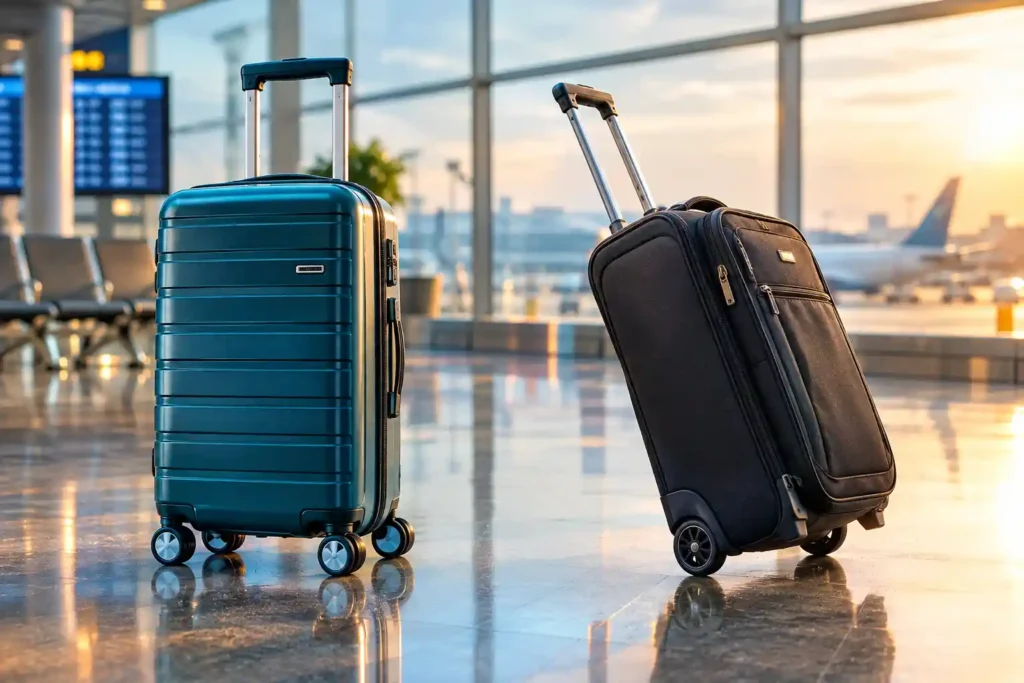
Roller luggage has two fixed wheels. You tilt the bag back and pull it behind you by the handle. People also call it a two-wheel, inline, or upright suitcase.
Travelpro traces the upright two-wheel design to 1987, when airline pilot Bob Plath built a suitcase that rolled on two wheels with a long handle. That invention grew into the Rollaboard. Your grandfather’s trip to Chennai would have looked very different without it.
One note on naming. Travelpro points out that only Travelpro makes true Rollaboard luggage, even though people use the word for any two-wheel bag. So “roller” and “Rollaboard” are not always the same thing.
Spinner vs Roller Luggage: Side-by-Side Comparison
Before the deep dive, here is the overview. Use it as a quick scan, then read the sections below for the reasoning.
| Factor | Spinner (4 or 8 wheels) | Roller (2 wheels) |
|---|---|---|
| Wheel movement | Rotates 360 degrees | Fixed, forward and back only |
| How you move it | Push, pull, or roll beside you | Tilt and pull behind you |
| Smooth floors | Excellent | Good |
| Rough ground and slopes | Weaker | Stronger |
| Wheel exposure | Wheels sit outside the shell | Wheels often sit recessed |
| Packing space | Often slightly less usable room | Often slightly more room |
| Typical build | Often hardside | Often softside |
| Best for | Airports, hotels, city trips | Cobblestone, hills, outdoor travel |
Treat the last three rows as tendencies. Brands mix and match, so verify each bag before you buy.
How Each One Handles Real Surfaces

Surfaces decide most of this debate. A wheel that behaves on marble can misbehave on gravel.
Smooth floors
Travelpro says four wheels give better maneuverability on smooth surfaces, because the wheels rotate 360 degrees while the bag stays upright beside you. You can weave around obstacles without twisting your wrist.
That is why spinners dominate airport scenes. It is also why they look so elegant in advertisements.
Rough ground, slopes, and cobblestone
Travelpro states that two wheels give a more durable and stable roll up steep hills and over uneven ground, such as cobblestone streets. You tilt the bag, and the two wheels carry the load behind you.
A spinner can still cross rough ground. You may need to tilt it onto two wheels, which defeats the point of owning four.
Stairs and station platforms
Neither type loves stairs. A spinner can drift on a sloped platform, because its wheels turn freely. A roller stays put once you stop pulling.
For travel by train or metro, this small difference matters more than it sounds. Look for spinner wheels with a brake if you use platforms often, or hold the handle at all times.
Durability: Which Wheels Last Longer?
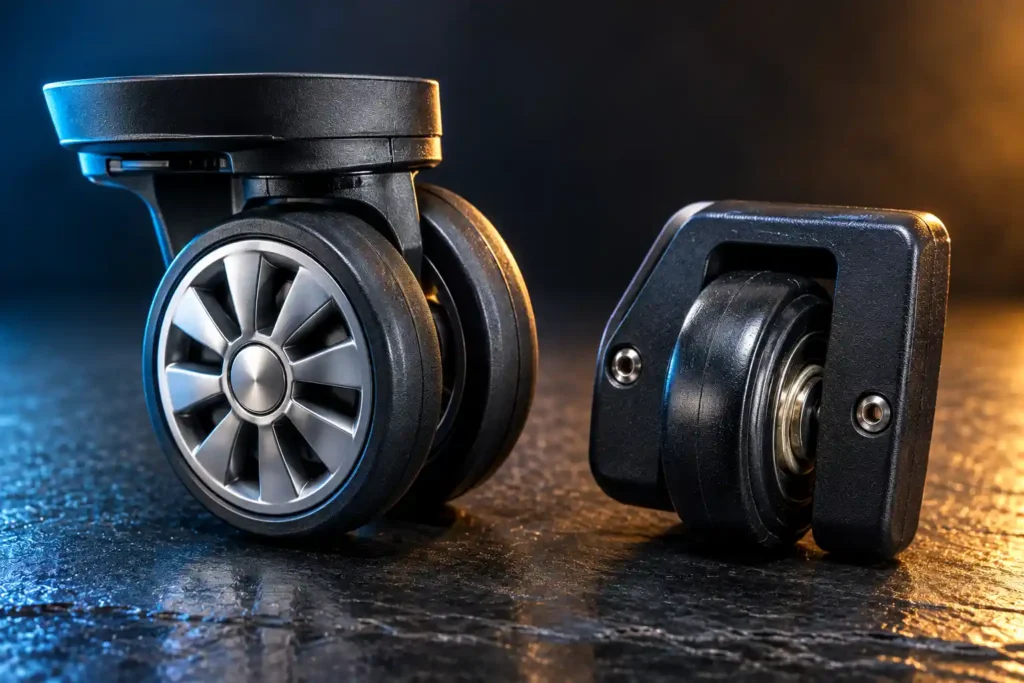
Wheel count matters less than wheel quality. Travelpro says more wheels is not always better, and that what goes into the wheels matters more than how many there are.
That is good news if you worry about a cheap four-wheeler losing a wheel at the worst moment.
Why rollers can last longer
Expert World Travel explains that roller wheels sit close to the luggage and move less, so they face less stress, and wheels cut into the body are very hard to break off. Fewer moving parts means fewer things to fail.
Why spinners can still last
Spinner wheels stick out and rotate, so they take more hits in handling. Better builds offset that with stronger wheels and mounts. Travelpro adds that eight wheels share the work, which lowers the chance of needing repairs or replacements.
Wheel materials worth knowing
Material often beats count. Travelpro lists three common wheel types: polyurethane, thermoplastic rubber, and other plastics. Here is how that source describes each one.
- Polyurethane: Strong and quiet. Travelpro calls it the highest quality option on the market.
- Thermoplastic rubber (TPR): A lower-cost option that tries to copy polyurethane. It can wear down or grip too much.
- Other plastics: Cheaper, but brittle. They can crack or chip.
Ball bearings matter too. Travelpro notes that quality bearings last longer and roll more smoothly than cheap ones. Check the product listing for wheel and bearing details before you pay.
Comfort and Ergonomics
Comfort depends on your body, your height, and your load. Here is how each style tends to feel.
With a spinner, the floor carries the weight. You push or guide the bag, and your arm stays relaxed. That feels great over long, flat terminals.
With a roller, you pull the bag behind you at an angle. Travelpro describes two-wheel luggage as carried behind you at an angle with your arm down at your side. It is steady, though it can tug on a tired shoulder after a long walk.
If you are tall, a telescopic handle that extends far enough is worth checking. If you are shorter, check that the handle height feels comfortable at its lowest setting. Try both in a shop if you can.
Packing Space and Weight
Packing behaviour changes the answer. Two bags with the same outer size can hold different amounts.
Wheels that stick out of a spinner can steal a little interior room, since the wheel housing takes space. Roller wheels are often recessed, which can leave a more open interior. This varies by model, so treat it as something to check, not a promise.
Weight matters even more on Indian flights. Cabin allowances are tight, and an empty bag eats into them. A heavier shell leaves you less room for clothes.
Spinner vs Roller Luggage for Indian Cabin Rules
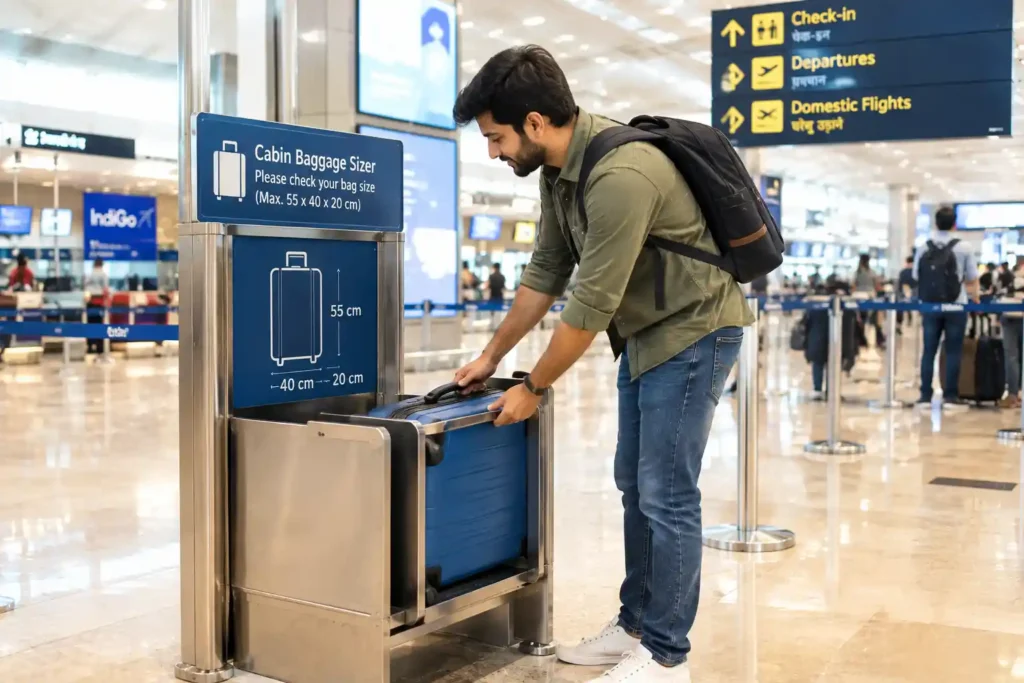
If you fly within India, the cabin limit deserves attention. IndiGo allows one cabin bag up to 7 kg and 55 x 35 x 25 cm, plus a personal item up to 3 kg and 45 x 35 x 20 cm.
Other airlines differ slightly. One 2026 guide reports that IndiGo, SpiceJet, and Akasa use 55 x 35 x 25 cm and 7 kg, while Air India differs at 55 x 40 x 20 cm and 8 kg. Rules change, so confirm the figures on your airline’s own website before you fly.
Here is the practical angle for the two styles.
- Spinner cabin bags: Wheels sit outside the shell, so measure the total height with wheels included.
- Roller cabin bags: Wheels are often tucked in, which can help a bag stay within the box.
- Both types: Weight counts. Check the empty weight before you add a single sock.
A bag that fits the sizer with room to spare saves you an awkward gate moment. Nobody wants to repack their underwear in front of a queue.
Who Should Buy a Spinner?
A spinner suits you if most of your travel looks like this.
- You fly often and walk through large, smooth terminals.
- You stay in hotels with lifts and flat corridors.
- You prefer to roll the bag beside you, or push it ahead.
- You travel with kids or a second bag and want one free hand.
Delsey says spinner luggage suits business trips, where speed and ease of movement matter. That fits common sense. A bag that follows you without effort saves a few minutes and a lot of irritation.
If you want to compare actual products, review of the Safari Pentagon Pro 8-wheel trolley bag and a write-up on the Aristocrat Liberty polypropylene hard spinner cabin bag. Both give a real-world view of how spinner builds behave.
Who Should Buy a Roller?
A roller suits you if your trips look more like this.
- You walk over cobblestone, gravel, or uneven pavements.
- You use ramps, hills, or long outdoor stretches.
- You want a bag that stays put on a sloped platform.
- You like hanging a second bag on top of your main bag.
On that last point, One Mile at a Time says it is less practical to hang a second bag off a spinner than off a roller. The writer is openly in the anti-spinner camp, so read that as one traveller’s view. Still, the practical point is fair.
Rollers also tend to be a calmer choice for people who dislike a suitcase that rolls away by itself. Gravity can be a rude travel companion.
Hard Shell, Soft Shell, and Wheels: Do They Connect?
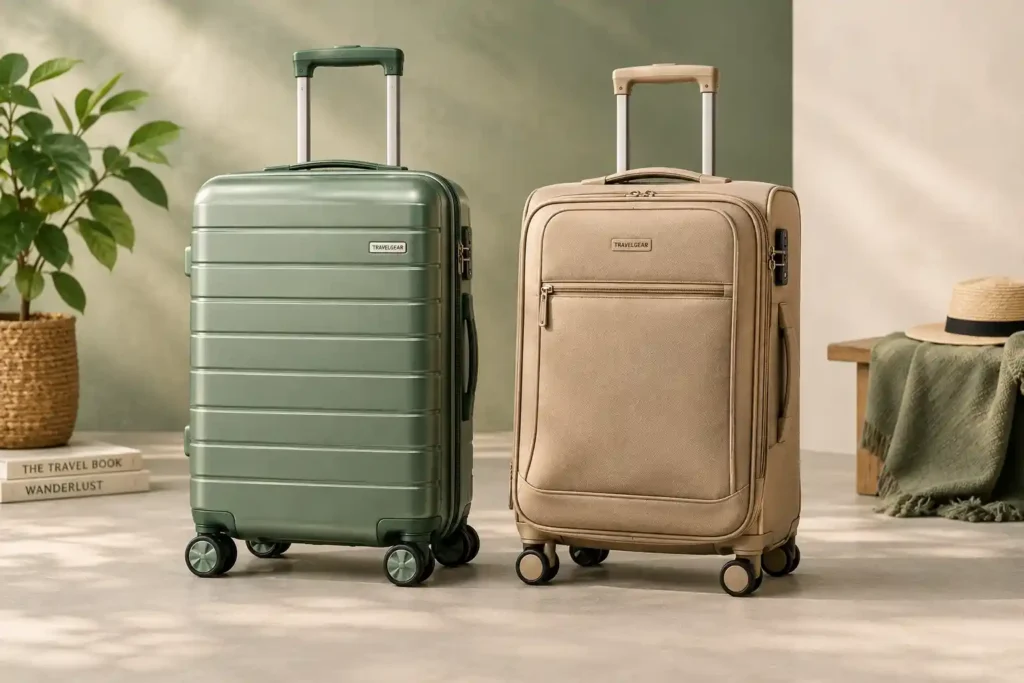
Wheel type and shell type are separate choices. They often travel together, though, so it helps to treat them as a pair.
Hardside bags can resist rain and protect fragile items. Softside bags often flex, which helps in a tight overhead bin. SwoopCart covers this in detail in its guide to hard luggage vs soft luggage.
Shell material also matters. If you are weighing options, the post on ABS vs polycarbonate luggage explains how common hardside materials differ.
Common Mistakes People Make
Even careful buyers slip. Here are the usual traps.
- Ignoring surfaces. A spinner on rough ground is a workout, not a convenience.
- Buying by wheel count alone. Eight cheap wheels do not beat four good ones.
- Skipping the weight check. A heavy empty bag cuts into your allowance.
- Forgetting wheel height. Measure the full bag, wheels included, against airline limits.
- Overpacking. Any suitcase handles badly when it is stuffed to its limit.
Fixing these five habits improves your trip more than any choice between the two styles.
Care Tips That Protect Your Wheels
A little care keeps any suitcase rolling smoothly.
- Lift the bag over kerbs and stairs instead of dragging it.
- Wipe dirt and grit from the wheels after wet or dusty trips.
- Avoid overloading the bag, since extra weight stresses axles and bearings.
- Check wheel screws and housing before a long trip.
Repairs are sometimes possible. Travelpro says that if a good bag loses or damages a wheel, you can often replace the wheels and keep using it. Check whether your brand sells spare wheels or offers a repair service before buying.
A Simple Decision Checklist
Answer these five questions, then count your answers.
- Do you mostly walk on smooth floors? A spinner gains a point.
- Do you often face rough ground or slopes? A roller gains a point.
- Do you want one-hand, side-by-side control? A spinner gains a point.
- Do you stack bags or hang a second bag? A roller gains a point.
- Do you ride trains with sloped platforms? A roller gains a point, unless the spinner has wheel brakes.
Whichever side leads, that is your starting choice. A tie means a spinner for flights and a roller or duffel for rough trips.
Final Verdict

Neither type wins everywhere. A spinner wins for smooth, busy, airport-style travel. A roller wins for rough ground and heavy-duty routes.
Choose by your own route, not by trend. One Mile at a Time observes that the luggage industry is moving more toward spinners. A trend is useful information, though it does not decide your next trip.
If you are ready to compare real options, browse trolley bag reviews. For a brand-level comparison, the post on Safari vs American Tourister is a good next read.
FAQs (Because People Keep Asking)
1. Is a spinner better than a roller bag?
It depends on where you walk. A spinner handles smooth floors better. A roller handles rough ground and slopes better.
2. Which lasts longer, a spinner or a roller?
Quality matters more than wheel count. Roller wheels often sit closer to the shell and face less stress, as Expert World Travel explains. A well-built spinner with strong wheels can last just as long.
3. Is a spinner good for cobblestone streets?
It can cope, though it is not ideal. Travelpro says two wheels roll more stably over uneven ground such as cobblestone. You may end up tilting a spinner onto two wheels.
4. Do spinner wheels fit within cabin size limits?
Only if the total height, wheels included, stays within your airline’s limit. On IndiGo the limit is 55 x 35 x 25 cm and 7 kg, according to WNTR’s 2026 guide. Always confirm with your airline.
5. Are eight-wheel spinners better than four-wheel ones?
They can be. Travelpro says eight wheels share the work and may reduce repair needs. Wheel material and bearing quality still matter more.
6. Which wheel material is best for luggage?
Travelpro rates polyurethane as the highest quality option. It is durable and rolls quietly. Check the product listing to see what a bag actually uses.
7. Can a spinner roll away on a train platform?
On a sloped surface, a free-turning wheel can drift. Hold the handle, or look for spinner wheels with brakes if you use platforms often.
8. Does a spinner or a roller suit frequent flyers better?
Frequent flyers who walk long, smooth terminals often prefer spinners. Delsey notes that spinners suit business trips where speed matters. Your own routes should make the final call.